
1891/1/12: Ebenezer to Agnes
Dreaming, options for Ebenezer's future, memories of Liddesdale in Scotland, his father's death, the nature of his and Agnes's relationship, Wordsworth, and his speech at the Presbyterian Church.

Calgary, N.W.T.
12, January : 1891.
My dear Comrade,
Frank brought me your letter of the 6th--which you must have been writing when I was writing my last letter to you--early this morn::ing, as I was sitting by my desk at the window of my room, chin on hand, looking out and Eastward, watching the sun rising over the painted gables, and dreaming of you and the Future. Ay, dreaming, my comrade!--but do not be angry with me. Is not dreaming the wine of life, if not the elixir, sus::taining us in act and labour? Living is dreaming; “We are such stuff as dreams are made of”1. Great deeds are all self-promised in making dreams. In the grave only will we be done with them.
Two courses are open to me for the immediate future. Before I take the one or the other, I must tell of them to you, and you will write me, faith::fully and frankly, what you think of them. Would that I could but run down the board-walk to the “other house”, and find you before the corner fire there, and talk with you about them!--but you are two thousand miles away.
Which of the two shall it be?--(or is there a third that suggests itself to that practical head of yours?) to return to Edinburgh, and, instead of depending wholly on literature, to patiently lecture in the schools and colleges, with my eye on the University, attaching myself to the libraries and devoting all available time to research and original work in Literature; or, once more to plunge into the mael-strom of literary London, with its infinite possibilities for good and evil. Que voulez-vous?2
There is a fascination about the London alternative which the Edinburgh scheme with its days and nights of toil lacks, but, like other fascinations, it may be born of Evil rather than of Good. But, my comrade, write me fully and unreservedly of all this and aught3 else that occurs to you with regard to this, and I shall, with bowed head, listen to all you say and I promise you to ponder it well.
To the idyllic life at Liddelbank4 I shall return no more. That way lie lyric poetry and moonlight dreams of sweet phantasy, but, as you suggest in your splendid letter that I received this morning, prose of fact and earnest thoughts and life has to be written now, and what poetry comes will be rather of the epic or dramatic character, dashed more with tragedy than comedy! What time or money I have devoted to that fair Border how that I love so well, I shall cheerfully resign to my sister and her dear children, in the affectionate hope that all may yet be well with them there in spite of the last unfortunate years5. But I cannot but wonder if the Kindly Fates will allow me to take you there for a little while, and to Liddesdale, to its woods and glens, haunted of primroses + hyacinths, to its hedge-rows + hill-sides, loud with the voices of birds. What happy pleasure to stand with you in Greena6, sweetest of hills shone on by the sun!--and to show you from its rounded summit all the valley of the Liddell7, fabulous as Hydaspes8, swung like a hammock among the hills and garlanded with woods, from the heights of bonnie Tevintdale9 to the gleaming Solway10; to show you from that Pisgah-height11 all the Border-land from green Selkirk12 to dark Northumberland13 and all its storied hills and mountains to Criffell14 with its memories of Burns15, to Hel::vellyn, Skiddaw and Blencathra16, with their memories of Words::worth, the Delectable Mountains of my childhood, all tremulous with legend, story, + romance, the very house of Poesie! There for fifty long years lived my saintly Father; there that dark, December dawn eleven years ago he died, and it seemed as if the sun had gone out of the heavens--as if the light of my life had gone out; and there, beneath an aged ash-tree in the lonely churchyard far up a hill-side that is first touched of the rising sun, he sleeps well--
“his part in all the pomp
That fills the circuit of the summer hills
Is that his grave is green.”17
What you write of your brother’s criticism on “Lear’s Fool”18 and of co-working and studying with me fills me with strange thoughts and my eyes with strange tears. Surely it cannot be amiss to cherish the thought labouring together somewhere, somehow, sometime--acting and re-acting on each other in the truest and highest sense, each supplying what the other most needs, each asking and receiving from the other what the other only can give. In that stern fight that we have now to go out to, sweet assistance of some kind will be needed lest alone we become too grim and self-contained. There is not much fear, I think, of our constituting ourselves into a mutual-admiration and mutual-adulation society! Alas, my comrade, may it not be too much the other way?--and in this connexion let us not for::get how our Valley19 got its mystic name. The earnestness of our feelings for each other’s well::being, the intensity of our emotions, should save us from that. Of mere admiration and adulation alas! We can get plenty anywhere if we wish it, if we lay ourselves open for it. And if any are satisfied with these things, verily let them have them for their reward. But what is all the applause of the world, the idiot gabble of the crowd of poor mortals, when once we have heard the sphere-music of the eternal verities pealing through our beings, and our souls have caught but a glimpse of the “light that never was on land or sea”20 except perhaps on that immortal sea
“which brought us hither;
Can in a moment travel thither--
And see the children sport
upon the shore
And hear the mighty waters
rolling evermore.”21
When I began this letter I fully intended to tell you of some of the social doings in Calgary--I am a pen hand at that sort of thing, but I should have done my best to interest you in some of these things--but I have got far enough away surely, to Liddesdale and Wordsworth’s Intimations of Immortality! But you shall have the letter with the gossip too some of these days.
I have quite got over my cold and my accident, and last night I delivered in the Presbyterian Church an oration in support of the Sabbath School22 and other organisations of the church to an immense audience that packed the building. From personal congratulations and news::paper notices I fancy I got on all right; but I shrink from speaking in a church, and how much rather I would at all times be silent than speak!
I regret that Chambers’s Journal23 procrastinates; perhaps a scolding will do the senders off the good they so much need.
With affectionate regards,
I remain,
Your Faithful Comrade,
Charlton.
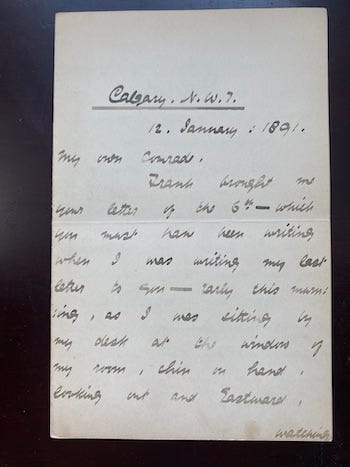
The first page of the original letter. Consider a paid subscription to see the full archive, including all letter images, footnotes and explanations, and upcoming multimedia features.


FOOTNOTES and EXPLANATIONS
A variation of a line from Shakespeare’s The Tempest: “We are such stuff as dreams are made on” (4.1).
Likely interpreted as, “What would you have me do?”
Arch. Anything.
Liddelbank was an estate on the Scottish Borders, an area abutting England. It is thought to have been a summer destination for the Black family. Though Ebenezer was raised in Edinburgh, genealogical records show that the Black family originated from the Border region. See Appendix B for a photograph and more detail on the structure.
At this point in transcribing the letters, the cause and consequences of these “unfortunate years” remain unclear.
Located near Canonbie in Dumfriesshire, Greena Hill rises above the Liddel Water, right in the heart of the Border country.
The Liddel Water forms part of the boundary between Scotland and England. The "valley of the Liddell" evokes a wild, wooded, romanticized landscape in the Border region.
The Hydaspes is the ancient Greek name for the Jhelum River in modern-day Pakistan — famously the site of Alexander the Great’s battle in 326 BCE.
A historic region in the Scottish Borders, associated with River Teviot, often called “bonnie” in Scots verse.
Refers to the Solway Firth, the inlet between southwest Scotland and northwest England.
Mount Pisgah is the mountain from which Moses viewed the Promised Land (Deuteronomy 34).
Selkirk, a historic town located in the Scottish Borders in the southeastern part of Scotland, lies on the Ettrick Water, a tributary of the River Tweed, and is surrounded by hills and pastoral countryside.
Northumberland, widely known for its rugged and dramatic landscapes, is the northernmost county of England and borders Scotland to the south.
Criffel is a hill in Dumfries and Galloway, visible from the Solway. The poet Robert Burns lived and died in nearby Dumfries. It’s often associated with his final years.
Robert Burns (1759–1796) was a celebrated Scottish poet and lyricist, widely regarded as the national poet of Scotland.
These are three major mountains in the Lake District: Helvellyn is famous in Romantic poetry, especially Wordsworth. Skiddaw is near Keswick, familiar to the Lake Poets. Blencathra, known as Saddleback, is another dramatic peak. These mountains are invoked as a poetic tribute to William Wordsworth, who immortalized this landscape in his verse.
From William Wordsworth’s poem A Poet’s Epitaph.
During this time in the literary scene, there was a raging debate about the character of the Fool in King Lear, with many people writing about it and weighing in on its function and appropriateness in the play.
Ebenezer playfully refers to the valley by different names; it appears to be the setting of an early rift—and a meaningful coming back together.
From Wordsworth’s “Elegiac Stanzas, Suggested by a Picture of Peele Castle in a Storm, Painted by Sir George Beaumont” in Elegiac Stanzas (Peele Castle), written in 1805.
From near the end of stanza IX from William Wordsworth’s “Ode: Intimations of Immortality from Recollections of Early Childhood” (often called the “Ode on Immortality”). The original line is “A light that never was, on sea or land, / The consecration, and the Poet's dream….”
What is now called Sunday School.
A popular Victorian-era periodical published in Edinburgh by W. & R. Chambers, founded in 1832. It is likely that he or another writer submitted a piece for publication.
